Danny O Exhibit
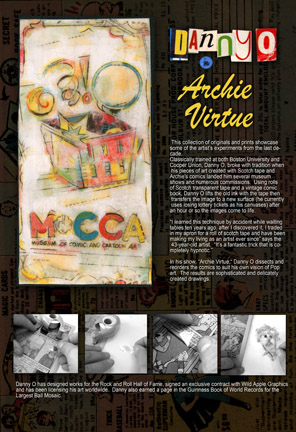
Original art pieces, made with both vintage Archie Comics and Scotch tape
September 6, through October 2005 |
Danny O On A Roll With Scotch Tape Company
Susan Bush - iBerkshires.com
North Adams – Some relationships are said to be “cemented,” but artist Danny O prefers tape.
The artist, whose original technique relies on a stick-to-it strategy, has signed on as the official spokesman for the 3M company’s 75th anniversary celebration of Scotch brand tape.
Known for a unique ink-on-tape art form and spectacular collage-style images created from just about any used paper he can get his hands on, Danny O said during a Sept. 2 interview that he was delighted by the invitation to represent the product.
“I was thrilled,” he said.
3M officials learned of Danny O while his work was displayed at the prestigious Chesterwood Museum in Stockbridge. About four months ago, Brian McIver, of the New York City-based Hunter Public Relations firm, contacted the artist, whose “real” name is Daniel O`Connor.
“I’m really excited and pleased to be the spokesperson for the 3M anniversary celebration,” O`Connor said.
A Little Tape Goes A Long Way
Personal appearances on the daytime and nighttime television talk show circuit are on his horizon because of his new role, O`Connor said. Specifics about the appearances are being ironed out and O`Connor said he should know more details in the near future.
Scotch tape is best known for its’ adaptability – more than one drooping hemline has been straightened with a piece of tape - but in O`Connor’s hands, the sticky household staple becomes a fine art tool, lifting ink from newspapers and comic books and dropping color and form against a canvas devised by O`Connor.
“One of the reasons I like tape is because it’s part of pop culture and it’s readily available,” O`Connor said. “For me, to be able to go any store and pick up a roll of Scotch tape and a newspaper means that I can make art for the rest of the day. It’s a compact studio.”
O`Connor’s favorite colored ink sources are vintage “Archie” comic books. The ink is easily lifted from the coarse paper pages and the hues are vivid, he said.
“I don’t see them as comic books,” O`Connor said. “I look at them and I see great arcs, pinks against reds; I start building with the stuff and pretty soon a design starts to happen.”
Danny O At the Museum of Cartoon and Comic Art
O`Connor and Museum of Cartoon and Comic Art Director Lawrence Klein had already exchanged casual conversation about a possible Danny O exhibit at the New York City museum.
“The museum was interested in me for a long time because I use Archie comics in my art,” O`Connor said.
Soon after agreeing to join the Scotch tape celebration, O`Connor contacted Klein. Connecting the anniversary with a museum exhibit and his use of comic books seemed a great idea, O`Connor said.
“I saw an opportunity to bring this together,” he said. “When I got the call from 3M, I called the museum and said ‘if we’re going to do this, now’s the time.’”
Klein agreed and Danny O’s “Archie Virtue” show is set to open at the museum on Sept. 6, which coincides with the 3M designated “birthday” of Scotch tape.
O`Connor, working as Danny O, has created unique portraits of the well-known cast of comic book personalities with a flair that brings his talented touch to the familiar faces. Creations called “Archie Poems” were designed from comic book text to generate witty and sometimes unusual word games that O`Connor likened to a past collaboration with poet Scott Zieher.
O`Connor’s ink-and-tape-and-comic-book method brings new meaning to the term “mixed medium,” blending a common household product with the cult status of classic cartoon good-guy Archie, brunette vixen Veronica, blonde girl-next-door Betty, and the comically hapless Jughead.
“You don`t think of tape as a fine art supply,” O`Connor said. “And Archie is iconic. Working with something as iconic as Archie – and something as discarded as Archie-I can make something cool and unique.”
A Shift From Tips To Tape
Danny O is frequently credited as being the first artist to create art with Scotch tape. He first experimented the technique after he noticed a transfer of color from one surface to another during a stint as a waiter. His artist`s eye was mesmerized by the effect.
“I learned this technique by accident while waiting tables 10 years ago,” he said. “After I discovered it, I traded in my apron for a roll of Scotch tape and have been making my living as an artist ever since.”
O`Connor studied art at the Boston University and the Cooper Union. His original line of Danny O t-shirts found a solid niche in Virginia during the 1980s and he also worked as a fine artist and illustrator in Boston.
But it was his collage work that brought recognition to Danny O, and his client list includes the Rock and Roll Hall of Fame Museum, Gillette, the Chesterwood Museum, The Boston Symphony Orchestra, Atlantic Records, Rounder Records, and numerous private collectors.
He was chosen to design the city-hosted Fall Foliage Festival Parade 50th anniversary “Golden Jubliee” brochure. O`Connor works from a downtown studio included as part of the Boxcar Media offices.
His constant use of recycled materials and his sheer talent are nothing short of brilliant, according to city resident and businessman Jack Bond.
Bond said that he is an admirer of the art.
“I continue to be amazed at the artwork that Danny O is able to produce from old items, everyday items, items from North Adams,” Bond said. “I own several pieces and I will own more.”
Take Things As Far As You Can
O’Connor has shared his technique with several art students and acknowledged that the teaching has a consequence.
“It’s a double-edged sword,” he said. “I’m giving away my trade secret, my signature.”
But others have likely considered trying the same process or a similar technique, O`Connor said.
“Using magazine paper is nothing new,” he said. “I try to create something unique with it. I like to take things as far as you can; you have glue, you have scissors, you have tape, now let’s see what you can do with it. Great ideas are just lying out there and are given to anyone who can pick it up and do something with it. Ideas are in the collective conscious.”
Information about Danny O may be acquired at the www.dannyoart.com Internet web site. Information about the 3M company Scotch tape 75th anniversary celebration may be acquired at the www.3m.com Internet web site.
Susan Bush can be reached via e-mail at suebush123@adelphia.net or at 802-823-9367.
|